2011-03-19

Hiatus

There is a going to be a pause now, a break in spacewordgame. Depending on a host of factors, it may resume shortly, or not.
Thanks!

2011-03-10

Maria

Maria are the plural of mare. A dark, flat, large region on the surface of the Moon. The term is also applied to the less well-defined areas on Mars. Although maria literally means “seas,” watery regions do not exist on the Moon or Mars. Marias on the Moon and elsewhere may be evidence of past volcanic lava flows. 


2011-03-09

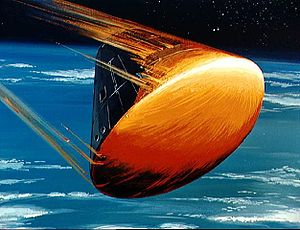
Ablative

Ablative means 'able to be eroded or flaked away'. An ablative heat shield is one in which the shield material itself vaporises and takes the heat away with it as it goes. The Apollo command module used an ablative heatshield made of a resinous material held in an aluminum honeycomb, and most entry and reentry vehicles use some form of ablative aeroshell in the same way.


2011-03-08

Catadioptric

Referring to an optical system which uses both reflection (mirrors) and refraction (lenses). This also describes the unwanted effect of lens elements reflecting images inside a compound camera lens. Undesirable catadioptric effects include ghosting and lens flares.

2011-03-07

Cislunar

Cislunar comes from the Latin, and is just a handy way to refer to all the space between the Earth and the Moon.
Cislunar Transfer

2011-03-04

Ullage

This is almost a second part to 'bladder'. Ullage is the volume in a closed container which is not occupied by the stored material, such as fuel. Its also sometimes used to refer to a manoeuvre deliberately to move floating fuel in a tank to the tank exit pipe. Dedicated ullage thrusters have been used during the Saturn IV-V era.


http://www.astronautix.com/craft/blo1s861.htm

2011-03-03

Retrograde

Retrograde means contrary to the normal direction of motion or rotation. A retrograde orbit is one that goes in the opposite direction of the rotation of the body being orbited. A retrograde manoeuvre opposes the direction of travel. Weirdly, 2 of the planets in the solar system have retrograde motion (on their own axes): Venus and Uranus. Venus' axial tilt is 177 degrees, so its spinning almost exactly in the opposite direction to its orbital rotation.

2011-03-02

Reseau

A reseau is a grid of points or marks placed in a photograph by a transparent plate very carefully and precisely aligned with the camera's optics. This provides a stable and reliable basis for measuring objects in a photograph and for detecting and correcting distortions in the photograph. The Hasselblad cameras used on the moon were fitted with reseau plates.
Reseau grid crosshairs just visible in the famous Aldrin shot

2011-03-01

Bladder

Bladders ought to be a fairly familiar concept, a stretchy membrane for containing fluids/gases. Bladders are relevant to space technology because they are used inside fuel tanks for at least 2 good reasons. Firstly, they confine the fuel into a volume roughly equal to the volume of fuel remaining, which prevents it from sloshing around and causing disturbances to the attitude control or GNC systems. Also, in a microgravity environment, it means you can keep the fuel in a partially filled tank close to the exit valve so you can use it. Easy really. Check out this page from Astrium about their bladder tanks.


2011-02-28

Quaternion

In case you remember or use complex ("imaginary") numbers, then quaternions are just a generalisation of complex numbers into 3 dimensions. They are enormously useful for attitude dynamics and anything which flies because they form a continuous representation without singularities. They were properly described by Hamilton in the 1840s, but have links with earlier work by Euler. A few decades later, people began to realise that vector analysis was much easier to think about and visualise, despite being less powerful. Vectors mostly won, and today quaternions are mostly used in spacecraft control, computer graphics, robotics, and signal processing.


There is no point trying to explain how quaternions work here. If you care, start with wikipedia, then build you own quaternion calculator in any language/system/tool you want. If you want to know why they are useful, then the principal argument is gimbal lock - (see previous entry about gimbals) - the loss of one degree of freedom in gimbal control.

2011-02-23

Gimbal

Gimbal is a fabulous and friendly word. A gimbal is a pivoted support, allowing rotation of a system around an axis. A pair of gimbals allows 2 axis rotation, usually configured to keep something locally horizontal. On boats, they keep galley stoves and deck compasses level. Rockets use gimbals to point their nozzles, and powered gimbals are found in control moment gyroscopes.


2011-02-22

Encke Gap


The Encke Gap (or previously, the Encke Division) is a gap in Saturn's ring system. It occurs in the so-called outermost 'A'-ring, and is about 325km wide. The gap is caused by the presence of the very small moon Pan. While its named after Johann Encke, he is not known to have observed it himself, he gets the honour for his general contributions to the observations of the rings.


2011-02-21

Kuiper belt

The Kuiper Belt is somewhat related to the Oort Cloud, which featured in the second ever post here. The Kuiper Belt is somewhat closer, and is a disk full of comets and other junk that lies between 30 and 50 AU from the Sun. This is close enough to include the former planet Pluto.


2011-02-18

Leptons

Leptons are elementary particles in the standard model, meaning they have no apparent further internal structure. The family of leptons includes electrons, muons, tau-lepton, a neutrino associated with each of these, and the set of anti-particle equivalents (but there is some fuzziness about antineutrinos... don't ask). They are named after the fractional parts of Greek currency from way-back-when. Technically, they have baryon number 0, unity electrical charge (+1, 0, or -1 e),  and zero colour charge. Leptons are involved in all types of physical interactions except the strong nuclear force. 

2011-02-17

Hypergolic

Hypergolic propellant refers to rocket propellants that spontaneously ignite when they come into contact with each other. Normally we call them the fuel and the oxidiser. While hypergolics are obviously very dangerous and require special handling on the ground, they are extremely useful in space because no ignition system is needed, which in itself would be complex, expensive, and take up mass  budget. The typical example in space applications is hydrazine, used together with nitrogen tetroxide.

2011-02-16

Dayside Reconnection

Dayside reconnection is exciting, unusual, and complex. To begin with, it is reconnection that occurs on the day side of the Earth (and presumably other planets with strong magnetic fields). But what is reconnection? It is the process by which magnetic fields are rearranged causing release of energy in the form of heat and kinetic energy, by accelerating local matter. Reconnection applies when magnetic fields from different sources (domains) become spliced together. This is really special because it seems to violate conservation laws in plasmas.
Its interesting to know about this from a space point of view for different reasons:

  • scientifically, reconnection occurs between the interplanetary magnetic field (IMF) and the Earth's magnetic field: on the dayside energy and particles arrive at low altitudes and contribute to the aurora, on the tail side it releases energy from the tail field and can cause aurora substorms.
  • technologically, devices have been made that determine the triggering of reconnection and its relationship to magnetospheric storms (NASA's THEMIS)
  • and for engineers, the ESA Cluster spacecraft have been watching all this stuff happen and have demonstrated that the physics is weird, it works, and can be beautiful.

Cluster


The wikipedia reconnection page and this article about flux transfer events are good starting points for further reading.

2011-02-15

Quasar

Quasar is more fun name for QSO - Quasi-Stellar Object. These are distant objects very highly redshifted so that they are bright in both optical and infrared bands, but also strong X-ray emitters. Quasars are unimaginably bright things, outshining galaxies. They are potentially close to supermassive black holes at the centres of very remote galaxies. Quasars are often found to have bright 'jets' of radio emissions 'focussed' by magnetic fields, such as illustrated below. Read more about quasars here.


NGC4261 Artist's Impression


2011-02-14

Hoop Conjecture


The Hoop Conjecture is a notion proposed in the early 1970s by Kip Thorne. The conjecture supposes that an imploding object forms a black hole when, and only when, a circular hoop with a specific circumference could be placed around the object and rotated. The critical circumference is 2 times Pi times the Schwarzschild radius for the object. This sounds rather arcane, but the idea is quite simple. What Thorne did was figure out the effects of gravity on different shapes, and decided that the only way gravity could make a black hole was if the object could be compressed in all 3 directions. Its somewhat akin to a magician claiming their floating assistant is not held up by wires, and demonstrating as much through a hoop conjecture: if the hoop can pass all the way over the assistant and be rotated at the ends, there are no wires. While nobody's made a hoop big enough to spin around a star so the conjecture remains a conjecture, most illusionists are also just illusionists and the pretty frock distracts you from the incompleteness of the demonstration. 
In short - objects only collapse into black holes when they are small enough in all directions (an infinite cylindrical star won't).


2011-02-11

Terminator

The terminator is the imaginary line that forms the boundary between the day side and the night side of a planet. In reality, it is a bit fuzzy depending on surface topology and atmospheric properties. The day/night terminator on Earth is an approximately circular line with radius approximately the same as that of Earth. There are a bunch of factors that drive exactly where the line falls and what shape it is.

The 1984 science fiction action film by James Cameron is not about nearly circular lines forming the boundaries of shadows on planetary surfaces.


2011-02-10

Nozzle

It is possible that you already have a good idea of what a nozzle is, but since it is a word with two 'z's in it, it deserves its place here. A nozzle is a mechanical device designed to control the direction or characteristics of a fluid flow as it exits an enclosed chamber via an opening. They have different meanings and applications in a wide variety of technologies, but the principal use of nozzles in space industry is in optimising the expansion ratio of exhaust products from the combustion chambers of rocket engines. The concepts apply equally to solid and liquid fueled engines. Nozzles come in a wide variety of sizes, usually integrate active cooling components, and are often mounted on gimballed mechanisms to aid guidance controls.


Rocket nozzle